
T: +86-137-0128-0809
E: sales@skyairdome.com
E: sales@skyairdome.com
UNIT 1406B, 14/F, THE BELGIAN BANK BUILDING, NOS. 721 - 725 NATHAN ROAD, KOWLOON, HONG KONG

Views: 0 Author: Site Editor Publish Time: 2025-11-27 Origin: Site


Ice sports are growing rapidly, and demand for year-round training and recreational facilities is higher than ever. Traditional ice rinks require heavy construction, long timelines, and high operational costs. An Ice Hockey Dome built as an air membrane supported structure offers a modern, cost-effective alternative. These air-supported ice rinks provide stable temperatures, flexible installation, and eco-friendly operation. Whether for professional teams, community programs, or seasonal events, an Ice Hockey Dome allows organizations to deliver high-quality ice experiences without the limitations of conventional facilities.
Air-supported structures are hollow buildings that rely on continuous air pressure instead of beams and pillars. They keep shape using internal air systems and strong membrane materials.
Some features:
Membrane thickness: 1000–1500 gsm
Fire-retardant PVDF or PVC coating
Light-transmitting surface for natural daylight
Can span large areas without columns
They are flexible. You can install them temporarily or use them permanently. Ice rinks built this way can be relocated easily.
An Ice Hockey Dome built with an air membrane supported structure offers a highly cost-effective solution compared to traditional ice rinks. Conventional rinks require heavy concrete foundations, steel beams, and lengthy construction schedules, which drive costs up. In contrast, air-supported structures need fewer materials and labor. The lightweight membrane allows simpler foundation designs, reducing both time and financial investment. On average, construction costs for an air-supported rink can be 30–70% of a traditional facility, while long-term maintenance and energy use remain significantly lower. This makes it ideal for organizations looking to build a budget-friendly Ice Hockey Dome without compromising functionality or safety.
| Type | Construction Cost | Maintenance | Energy Use |
|---|---|---|---|
| Traditional rink | 100% | High | High |
| Air-supported rink | 30–70% | Low | Low |
The installation of an Ice Hockey Dome using an air membrane supported structure is remarkably fast. The main structure can be ready within a month, far quicker than conventional rink construction. Its modular design allows for easy relocation, disassembly, or expansion as needs change. Facilities can adjust rink size or interior layout, making them suitable for temporary events, seasonal operations, or multi-purpose sports centers. This flexibility ensures organizations can adapt and reuse their Ice Hockey Dome efficiently, saving both time and resources while maximizing facility usage throughout the year.
Ice sports require stable temperatures and humidity to maintain high-quality ice surfaces. Traditional rinks often stop operation during warmer months due to natural temperature fluctuations. An Ice Hockey Dome built as an air membrane supported structure solves this problem by maintaining constant indoor conditions. Variations rarely exceed 0.3°C, allowing athletes to train safely and consistently all year long. Schools, sports clubs, and recreational centers benefit from this predictable environment, while children can attend multiple classes per week without interruptions. This controlled space ensures consistent ice quality, indoor comfort, and a safe environment for players and spectators regardless of external weather conditions.
An Ice Hockey Dome using an air membrane supported structure is also environmentally conscious. The membrane material naturally insulates the rink, reducing the energy needed for heating and cooling. Its high light-transmitting properties make full use of daylight, minimizing artificial lighting during daytime hours. Construction produces low noise, generates minimal waste, and uses recyclable, carbon-free materials. In practice, this translates into lower operating costs, reduced carbon footprint, and sustainable construction. Organizations benefit from a green, energy-efficient facility that can support long-term operations without excessive environmental impact.
Despite their lightweight design, Ice Hockey Domes with air membrane supported structures are incredibly strong and resilient. The internal air pressure supports the entire building, allowing it to withstand heavy snow loads, strong winds, and even typhoons of level 16 strength. Fire safety is ensured by B1-rated membranes, and modular entrances provide secure access for players, staff, and spectators. Automated systems maintain internal air pressure, while the beam-free design reduces structural hazards. These features make the Ice Hockey Dome both flexible and safe, capable of hosting large crowds or professional training events without compromising stability or security.
Air-supported ice rinks are highly versatile and can be adapted for multiple purposes.
Professional training centers
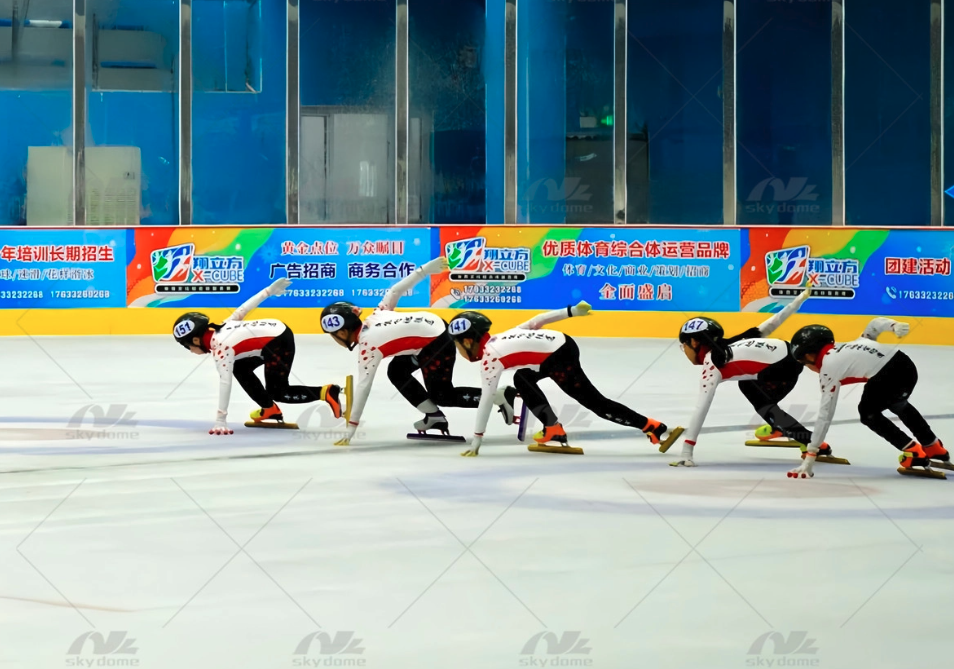
An Ice Hockey Dome using an air membrane supported structure provides year-round training. Athletes can practice under stable temperature and humidity. Coaches benefit from a controlled environment for performance monitoring.
Recreational rinks
Schools and community centers can host skating programs, hockey lessons, or recreational skating. The controlled conditions ensure safe ice surfaces regardless of weather.
Seasonal events and exhibitions
Air domes can be installed quickly for competitions, ice shows, or winter festivals. After the event, they can be dismantled and reused elsewhere.
Multi-sport and entertainment venues
Ice rinks can coexist with other sports facilities. The modular nature allows flexible layouts for events, concerts, or shows.
The structure scales easily. It can cover small community rinks or large professional arenas, making it a flexible, cost-effective solution for many organizations.
Site selection: Choose level ground, accessible location, and low environmental risk.
Size & capacity: Decide based on athlete numbers, spectators, and events.
Materials: Select PVDF/PVC membranes suitable for local climate.
Temperature control: Plan heating, cooling, and ice-making systems.
Maintenance: Schedule membrane inspections, air system checks, and ice resurfacing.
| Task | Description / Notes |
|---|---|
| Determine rink dimensions | Decide length, width, and overall layout |
| Select membrane & insulation type | Choose PVDF/PVC membrane and insulation |
| Choose air control system | Plan ventilation, pressure, and monitoring |
| Plan lighting & utilities | Include electricity, lighting, and HVAC |
| Schedule routine inspections | Regular checks for membrane and systems |
An Ice Hockey Dome is an air-supported ice rink that relies on internal air pressure and a durable membrane to maintain its structure, providing a flexible and cost-effective alternative to traditional ice rinks.
Installation is typically fast, with the main structure ready within a month, thanks to the lightweight air membrane supported structure.
Yes, these domes maintain stable indoor temperature and humidity, allowing athletes to train or play regardless of outdoor weather conditions.
Yes, the membrane naturally insulates the rink, reduces energy needed for heating or cooling, and allows natural daylight to reduce artificial lighting requirements.
Air membrane supported structures are designed to withstand heavy snow, strong winds, and even level 16 typhoons, while fire-retardant membranes and controlled air pressure ensure safety.
Choosing an Ice Hockey Dome with an air membrane supported structure provides unmatched flexibility, energy efficiency, and cost savings. From professional training centers to community recreational rinks, these air-supported ice rinks make it possible to host year-round ice activities safely and reliably. For organizations looking to implement a high-quality, sustainable ice sports facility, Sky Dome Co., Ltd. offers expert design, installation, and support, helping you bring your ice rink project to life efficiently and affordably.


