
T: +86-137-0128-0809
E: sales@skyairdome.com
E: sales@skyairdome.com
UNIT 1406B, 14/F, THE BELGIAN BANK BUILDING, NOS. 721 - 725 NATHAN ROAD, KOWLOON, HONG KONG

Views: 0 Author: Site Editor Publish Time: 2026-09-25 Origin: Site


Unpredictable weather, stringent environmental regulations, and urban noise ordinances are primary drivers of project delays and cost overruns in modern construction. Traditional weather protection methods often fail to provide adequate clear-span coverage. Plastic sheeting, scaffold wraps, and standard industrial tents struggle to deliver climate control or high-wind durability for large-scale active sites. These legacy methods leave projects vulnerable to sudden storms, temperature drops, and environmental compliance violations.
A construction site air dome offers a scalable, structurally sound alternative. This pneumatic technology replaces fragile temporary covers with a highly engineered, pressurized environment. This guide examines the technical viability, operational trade-offs, and financial implications of deploying inflatable enclosures for temporary projects. We evaluate site requirements, mitigate deployment risks, and outline how to select the right structural membrane for your next major build.
Clear-Span Capability: Air domes provide massive, column-free temporary construction enclosures, allowing unimpeded operation of heavy machinery and cranes indoors.
Environmental Control: Specialized applications, such as a foundation pit air dome, drastically reduce fugitive dust, volatile organic compounds (VOCs), and noise pollution in dense urban environments.
Operational Continuity: By neutralizing weather variables (snow, rain, extreme temperatures), construction air domes protect project timelines, prevent material degradation, and ensure continuous facility operation during overhead renovations.
Supplier Dependency: Successful deployment requires partnering with an experienced air dome supplier capable of handling site-specific engineering, custom airlock logistics, and continuous power redundancy.
Legacy temporary building structures present significant operational limitations on active job sites. Traditional plastic sheeting and suspended cover systems suffer from severe failure points under moderate environmental stress. Wind shear easily rips standard plastic wraps from scaffolding, snapping tie-downs and exposing the work area. These basic covers provide almost zero thermal insulation. Site crews waste valuable hours repairing and replacing torn sheeting after minor weather events, causing unacceptable operational downtime and labor waste.
Aluminum-frame industrial tents offer a step up in durability but introduce rigid physical constraints. They suffer from strict span limitations. Erecting a massive steel or aluminum frame requires heavy lifting equipment, extensive ground preparation, and lengthy installation times. These rigid structures also demand significant structural footprint requirements. Internal support columns obstruct the movement of excavators, cranes, and material handlers. Maneuvering heavy machinery around a grid of steel pillars slows down material transfer and increases the risk of equipment collisions.
Pneumatic structures solve these physical limitations entirely. A modern construction site enclosure utilizes internal air pressure to support a massive architectural fabric canopy without a single internal column. Heavy-duty blowers maintain a slight overpressure inside the dome, holding the structure rigid against external wind and snow loads. Manufacturers build these domes using highly flexible, tough, and weather-resistant materials like PVC or PVDF. These industrial fabrics resist tearing, block UV degradation, and withstand the highly abrasive nature of active construction environments.
Site managers must evaluate the maximum required clear-span width to ensure cranes can rotate fully without striking internal supports.
Engineering teams must calculate the exact wind load requirements based on the geographical location and historical weather data.
Project planners must assess the ground conditions to determine if the site can support traditional concrete footings or if temporary anchoring is required.
Safety officers must review the fire retardant ratings of any temporary enclosure material before deployment over active hot work zones.
Urban excavation projects face intense scrutiny from municipal authorities and neighboring property owners. Deep excavations generate massive amounts of silica dust. Contaminated soil remediation releases volatile organic compounds and foul odors into the surrounding air. Heavy excavators, rock breakers, and pile drivers create deafening noise that violates local ordinances. A foundation pit air dome completely seals the excavation site, acting as a massive physical barrier between the raw earthworks and the city.
This containment strategy keeps projects compliant with strict municipal regulations. The dome traps fugitive dust before it reaches neighboring properties or public streets. Integrated air filtration systems scrub VOCs and odors from the exhaust air before it leaves the pressurized envelope. The heavy architectural fabric also dampens heavy equipment noise significantly. Site managers can operate machinery earlier in the morning or later at night without triggering noise complaints, effectively extending the daily working window and accelerating the excavation phase.
Weather dictates the pace of active construction. Concrete pours require specific temperature and humidity ranges to cure properly and achieve design strength. Freezing temperatures destroy masonry work and halt structural steel welding. A construction air dome creates a controlled microclimate over the active build. Site teams can maintain strict temperature parameters regardless of a blizzard or heatwave outside. This prevents curing failures, eliminates the need for localized ground heaters, and keeps the critical path moving forward.
Overhead renovations present another massive logistical challenge. Replacing a roof on an active manufacturing plant, water treatment facility, or commercial building risks exposing the interior to debris and weather. Deploying an air dome over the existing structure acts as a massive temporary ceiling. This keeps the facility below clean, code-compliant, and fully operational. Construction workers can tear off the old roof and install the new system while the business continues running uninterrupted beneath the protective pneumatic canopy.
Construction sites require massive staging areas for raw materials. Moisture-sensitive materials like drywall, engineered timber, and cement degrade rapidly if left exposed to the elements. Standard tarps provide inadequate protection against ground moisture and driving rain. Air domes serve as highly efficient temporary warehouses. They offer immense volumetric space to stack materials safely out of the elements, reducing material waste and preventing rework caused by water damage.
These structures also provide secure storage for heavy machinery fleets. Leaving expensive excavators, loaders, and specialized tools exposed invites theft, vandalism, and weather damage. Parking equipment inside a locked, enclosed dome maximizes site storage efficiency. It protects sensitive hydraulic systems from freezing rain, keeps engine blocks warm for easier morning starts, and prevents unauthorized access to the fleet during off-hours.
Crew safety and morale directly impact project velocity and quality. Extreme weather causes heat stress in the summer and frostbite risks in the winter. Providing expansive, safe, and temperature-controlled lunch and break environments is mandatory for large crews on mega-projects. Air domes offer vast open spaces where hundreds of workers can gather comfortably, dry off their gear, and rest.
A climate-controlled break area boosts productivity significantly. Workers recover faster when they can escape freezing winds or scorching sun. This proactive approach to worker welfare reduces accident rates caused by fatigue and physical strain. It also helps project managers meet strict occupational health and safety guidelines regarding extreme weather exposure, ensuring the site remains compliant with labor regulations.
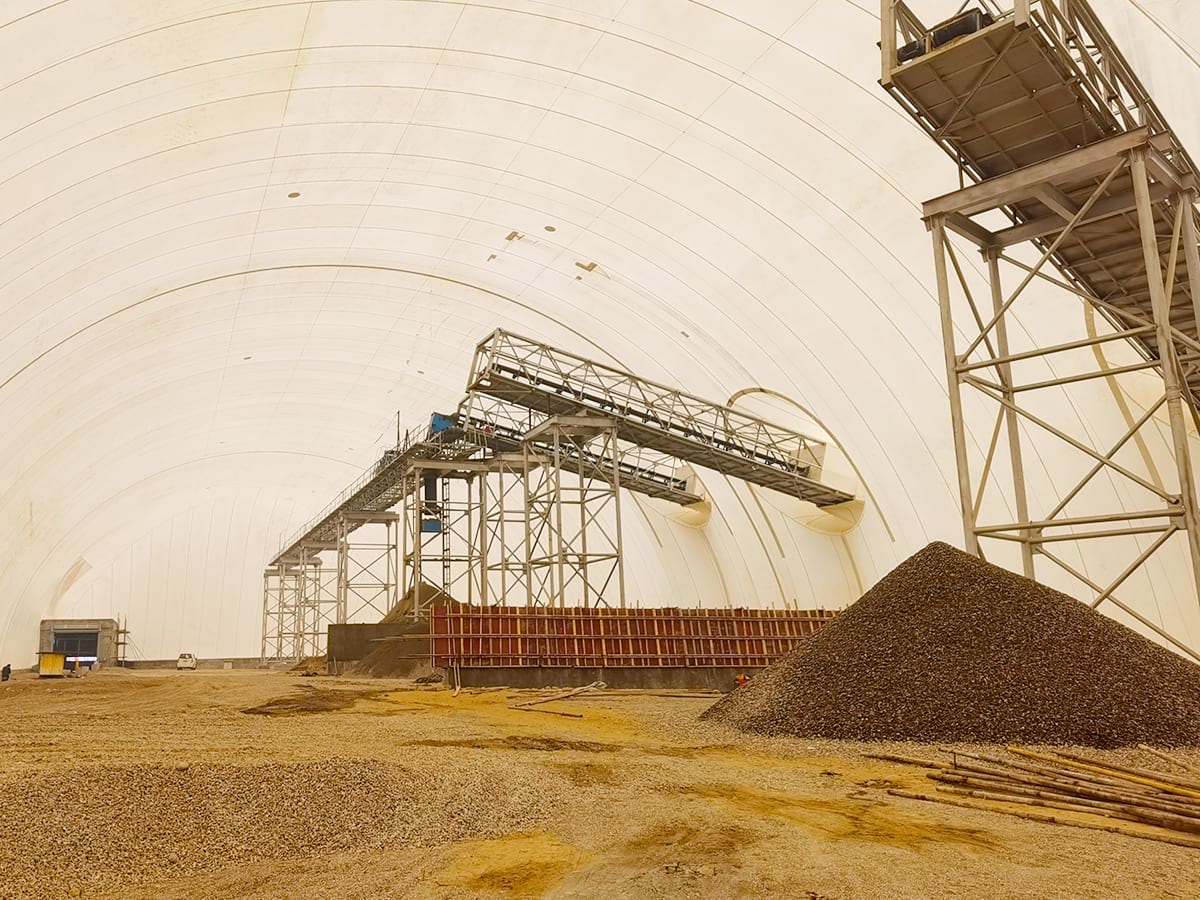
Clear-span capability separates pneumatic structures from traditional tents. Large-scale industrial tents require internal columns to support wide roof spans. These columns dictate traffic flow, limit where you can operate cranes, and create blind spots for heavy equipment operators. Air domes offer unlimited clear-span capabilities, often exceeding 300 feet in width. The internal air pressure supports the entire roof, providing a massive, completely open interior volume that accommodates any site layout.
The perimeter anchoring footprint also differs drastically. Traditional temporary weather enclosures often require extensive scaffolding, deep ground penetrations, and massive concrete footings to resist wind loads. Air domes utilize a continuous perimeter anchoring system. Depending on the site conditions, crews can secure the dome using concrete ballast blocks, earth anchors, or a simple grade beam. This reduces the structural footprint, simplifies site preparation, and minimizes ground disturbance.
Thermal efficiency is critical for temporary enclosures in extreme climates. Standard plastic sheeting bleeds heat instantly, wasting fuel used for temporary heaters. A temporary construction enclosure built with pneumatic technology offers superior insulation. Project managers can choose between single-layer fabrics for basic weather protection or double-layer insulated dome fabrics for harsh winters. The trapped air between the double layers acts as a highly effective thermal barrier, significantly increasing the R-value of the structure.
HVAC integration capabilities make air domes highly efficient to operate. Standard tents suffer from massive energy loss through seams, unsealed edges, and overlapping flaps. Air domes are virtually airtight by design to maintain internal pressure. This allows HVAC systems to recirculate and condition the internal air efficiently. Sites spend less energy heating or cooling the space because the pressurized envelope prevents drafts and thermal bridging.
Construction environments destroy weak materials rapidly. Standard plastic sheeting tears against sharp scaffolding edges. High winds shred basic tarps within weeks. Modern air domes utilize tear-resistant, high-quality flexible materials. These industrial-grade PVC and PVDF membranes withstand abrasive dust, flying debris, and intense UV exposure. They significantly outperform standard job site tents and require zero mid-project replacement.
Code compliance relies on proven engineering and rigorous testing. Pneumatic structures carry strict wind load and snow load ratings. Engineers design the fabric tension and internal pressure to withstand hurricane-force winds, often exceeding 120 mph. Cable-net reinforcement systems handle massive snow accumulations by distributing the weight across the membrane. These engineered ratings ensure the structure meets local building codes for temporary structures and passes municipal safety inspections.
Technical Specification | Pneumatic Air Dome | Industrial Steel Frame Tent | Scaffold Wrap / Sheeting |
|---|---|---|---|
Clear-Span Width | Unlimited (No internal columns) | Limited (Requires support pillars) | N/A (Follows scaffold frame) |
Installation Speed | Very Fast (Days) | Slow (Weeks) | Moderate (High labor hours) |
Thermal Efficiency | High (Double-layer air pocket) | Low to Moderate | Zero (High heat loss) |
Wind/Snow Resistance | High (Engineered tension/pressure) | Moderate to High | Very Low (Prone to tearing) |
Heavy Machinery Access | Excellent (Via specialized airlocks) | Poor (Obstructed by columns) | N/A (Exterior only) |
Acoustic Dampening | High (Contains heavy equipment noise) | Low | Zero |
Prolonged setup times threaten project schedules. Waiting weeks for a temporary structure to be erected delays the start of protected construction phases. Every day spent building a tent is a day lost on the actual project timeline. Heavy steel-framed industrial tents require extensive crane work, massive labor crews to bolt together steel trusses, and significant heavy equipment coordination.
Air domes mitigate this risk through rapid inflation capabilities. Once the perimeter anchoring is prepared, crews unroll the membrane, secure it to the foundation, and activate the blowers. The structure inflates and becomes rigid in a matter of hours. You can deploy an air dome significantly faster than erecting a traditional steel building, provided your site preparation is optimized and the anchoring system is fully cured or tested.
Grade and level the perimeter footprint to ensure a tight seal for the anchoring system.
Install the chosen anchoring method, such as helical piles or continuous concrete grade beams.
Unroll the architectural fabric membrane across the site, ensuring no sharp debris punctures the material.
Secure the membrane to the perimeter anchors using the engineered clamping system.
Install the vehicle and pedestrian airlocks, sealing them to the fabric envelope.
Activate the primary blower units to inflate the structure and achieve operational pressure.
Pneumatic structures rely entirely on continuous internal air pressure. Deflation due to grid power failure is the primary operational risk. If the blowers stop, the dome will slowly lose pressure and descend. This poses a severe risk to the equipment, active work, and personnel below.
Mitigating this risk requires mandatory power redundancy. Sites must integrate automated backup generators into the inflation system. Redundant blower units ensure that if one motor fails, another instantly takes over. Modern systems use smart-monitoring telemetry to track internal pressure, wind speed, and power status. These sensors send instant alerts to site managers if pressure drops, ensuring continuous structural integrity and allowing for immediate mechanical intervention.
Moving people and heavy equipment in and out of a pressurized environment presents a logistical challenge. Opening a standard door allows air to escape, causing rapid pressure loss. This creates workflow bottlenecks during equipment ingress and egress. Dump trucks, excavators, and concrete mixers need seamless access without compromising the structural integrity of the dome.
You solve this by sizing and engineering heavy-vehicle airlocks. These airlocks feature interlocking doors. The outer door opens, the truck enters the chamber, and the outer door closes. The inner door then opens to allow access to the site. Revolving pedestrian doors handle foot traffic efficiently without pressure loss. Site crews must maintain strict operational discipline to ensure doors are never propped open, preserving the pressure envelope at all times.
Inadequate anchoring leads to catastrophic structural failure. High winds exert massive uplift forces on the expansive fabric canopy. If the temporary setup lacks sufficient ground hold, the dome can shift, detach, or collapse. You cannot cut corners on foundation engineering when deploying pneumatic structures.
Evaluate temporary anchoring solutions based on strict soil condition testing and project duration. Earth anchors provide excellent hold in dense soils and are easily removed post-project. Concrete ballast blocks offer a non-penetrating solution for sites with existing pavement or sensitive underground utilities. Helical piles deliver maximum pull-out resistance for long-term deployments in loose or sandy soil. The chosen method must match the engineered wind load requirements exactly.
Deciding between purchasing a custom dome or leasing one requires a clear operational framework. Multi-year or multi-phase projects often justify the capital expenditure of a custom-built dome. You own the asset and can reuse it across different sites, modifying the airlocks as needed. For short-term needs spanning only a few months, leasing from an established provider makes more financial sense. It removes the burden of long-term storage, membrane maintenance, and specialized transport.
Calculating the financial offset of an air dome requires looking beyond the initial deployment cost. You must quantify the eliminated weather delay days. Count the wages saved by keeping crews productive during rain, snow, or extreme cold. Calculate the reduced winter heating costs achieved by the dome's thermal efficiency compared to heating an open site. Factor in the avoidance of environmental non-compliance fines for dust or noise violations. These operational savings quickly offset the deployment expenses.
You must also assess the lifecycle and relocation logistics. Moving the dome to a subsequent job site involves specific labor and transport costs. You need specialized crews to dismantle the airlocks, deflate the membrane safely, and fold the massive fabric sections. Transporting the heavy membrane requires flatbed trucks and careful handling to avoid punctures. Re-inflating the dome at the next site requires new site preparation and anchoring. Factor these relocation logistics into your long-term project planning to ensure accurate budgeting.
Deploying a massive pneumatic structure is not a standard equipment rental. It requires deep technical expertise and precise engineering. You need a supplier who provides site-specific structural engineering stamps. Generic plans will not pass local municipal code inspections. The supplier must also design custom airlocks tailored to the exact dimensions, turning radii, and height of your heaviest machinery.
Evaluate the supplier's installation and maintenance service level agreements (SLAs). An experienced air dome supplier must take an active role in the initial setup. They should provide comprehensive crew training on airlock operation, pressure monitoring, and emergency procedures. Scrutinize their guaranteed response times for mechanical failures. If a blower motor fails at midnight or a sensor malfunctions, you need a technician on-site immediately to prevent deflation.
Material quality separates professional suppliers from inferior vendors. Ensure the supplier uses industrial-grade membranes specifically designed for construction applications. The fabric must be fire-retardant to meet strict construction site safety codes and hot work regulations. It must feature high UV resistance to prevent degradation under constant sunlight. Request material specification sheets to verify the tensile strength, tear resistance, and thermal properties of the proposed fabric before signing any contracts.
Audit your upcoming winter or urban excavation projects to identify sites where weather delays, dust containment, or noise ordinances threaten the critical path.
Calculate the historical financial impact of weather-related downtime, including idle labor and equipment rental extensions, to establish a baseline budget for temporary enclosures.
Measure the exact dimensions and turning radii of your largest heavy machinery to determine the required vehicle airlock specifications.
Request a site-specific engineering consultation to evaluate soil conditions for temporary anchoring and verify local municipal permitting requirements.
A: Air domes are highly engineered structures. They easily withstand hurricane-force winds exceeding 120 mph depending on the internal pressure and anchoring system. For snow, engineers integrate cable-net reinforcement systems to handle heavy loads. Automated heating systems can also be activated to melt snow accumulation before it exceeds structural limits.
A: It is a specialized pneumatic structure deployed directly over open urban excavations. It acts as a massive containment shield during the foundational phase of construction. The dome traps hazardous silica dust, filters volatile organic compounds from contaminated soil, and dampens the severe noise generated by pile drivers and heavy excavators.
A: The dome features a completely column-free interior, providing massive clear-span space for crane swings. Machinery enters through specialized vehicle airlocks. These chambers use interlocking doors. A dump truck drives into the airlock, the outside door closes, and the inside door opens. This prevents internal air pressure loss during transit.
A: The decision depends on project duration. For short-term projects under 12 months, renting avoids long-term storage and maintenance burdens. If you manage multi-year mega-projects or have recurring seasonal needs across different sites, purchasing a custom dome offers a better return on investment over its lifecycle.
A: Modern air domes feature robust fail-safe mechanisms. If grid power fails, automatic standby generators instantly activate to keep the blowers running. Even in a total mechanical failure, the dome does not pop. It deflates very slowly over several hours, providing ample time for crews to safely evacuate the equipment and personnel.
A: Yes. Municipalities typically classify them as temporary structures, but they still require strict oversight. You must submit site-specific engineered drawings stamped by a licensed professional. These drawings prove the structure meets local wind, snow, and fire codes before the city issues a temporary deployment permit.


