
T: +86-137-0128-0809
E: sales@skyairdome.com
E: sales@skyairdome.com
UNIT 1406B, 14/F, THE BELGIAN BANK BUILDING, NOS. 721 - 725 NATHAN ROAD, KOWLOON, HONG KONG

Views: 0 Author: Site Editor Publish Time: 2026-09-30 Origin: Site


Deep excavation and foundation work carry massive financial risks when weather hits. You cannot control rain, snow, or freezing temperatures. You also cannot ignore municipal stop-work orders when neighbors complain about noise and dust. Traditional open-air excavation leaves your critical path schedule completely exposed. Relying on temporary tarps or piecemeal scaffolding fails on large-scale urban developments. They tear, they leak, and they slow down your crews.
Deploying a foundation pit air dome changes how you manage a site. You move from reacting to weather to working inside a proactive, climate-controlled environment. This pneumatic structure isolates your excavation zone. You get continuous operational uptime regardless of the season. Sealing the site keeps you compliant with local regulations. You eliminate community disruptions and control emissions directly at the source.
All-Weather Continuity: Enclosing the site eliminates weather-related downtime, keeping the pit dry and stable to enable 24/7 excavation and concrete pouring schedules.
Regulatory Compliance: Advanced filtration and acoustic barriers achieve near-zero external emissions, satisfying strict urban mandates for dust control and noise reduction.
Rapid Deployment: Modular design and pneumatic inflation allow for significantly faster installation and site protection compared to traditional scaffolding or hard-shell covers.
Cost vs. Value: The high initial setup cost is frequently offset by accelerated project timelines, eliminated environmental fines, and reduced winter-heating expenses.
Vendor Selection: Choosing the right air dome manufacturer requires rigorous evaluation of structural load capacities, HVAC integration, and emergency deflation protocols.
Defining success during the excavation phase means hitting your milestones on time. You need zero safety incidents, zero municipal fines, and zero complaints from the neighborhood. Hitting these targets in an open-air pit is tough. Weather and urban density fight your schedule every single day. Site managers constantly battle water ingress. Freezing ground ruins concrete pours. Airborne dirt threatens worker safety and angers local residents. When you are digging forty feet down in a dense city grid, you cannot afford a three-day delay because of a rainstorm.
Traditional methods fail against fully enclosed pneumatic structures. A standard foundation pit cover built from temporary tarps or metal scaffolding wastes time. Tarps rip in high winds. Scaffolding takes weeks to erect. Neither gives you a true seal against extreme temperatures or heavy rain. These piecemeal setups require constant manual adjustments. You end up pulling laborers off actual construction tasks just to tie down flapping plastic. This increases the risk of site accidents during severe weather. You also face the constant threat of scaffolding collapse if wind loads exceed the temporary engineering limits.
Protecting soil and foundation integrity matters most during early construction stages. Keeping the excavation site completely dry stops soil erosion. You eliminate mud-related machinery delays. Trench walls and shoring systems stay stable during heavy rainfall. When water accumulates in an open pit, you have to run diesel pumps all day. This delays concrete pours and weakens retaining walls through increased hydrostatic pressure. An enclosed environment removes moisture variables. Engineers can proceed with precision grading, lagging, and foundation laying without waiting for the mud to dry.
Evaluating the financial impact requires looking at hard numbers. Project stakeholders must quantify the daily cost of halted operations. Idle heavy machinery rentals eat into margins. Extended labor contracts drain the budget. Compare these losses against the investment of a temporary pneumatic structure. Factor in potential environmental penalties for dust emissions. Add the revenue lost from delayed project handovers. The initial capital expenditure of an enclosed dome frequently proves highly economical for complex urban builds. You stop paying crews to stand around waiting for the weather to clear.
Site Condition | Traditional Open-Air / Tarp Covers | Pneumatic Air Dome Enclosure |
|---|---|---|
Heavy Rainfall | Requires extensive pumping; mud stops heavy machinery. | 100% dry interior; grading and pouring continue uninterrupted. |
Sub-Zero Temperatures | Ground freezes; concrete curing stops; workers risk frostbite. | Climate-controlled; ground stays workable; safe for crews. |
Urban Dust Regulations | High risk of fines; dirt escapes site boundaries easily. | Negative pressure traps dirt; scrubbers clean exhaust air. |
Installation Speed | Scaffolding takes weeks to erect and dismantle. | Inflates in days after foundation anchoring is complete. |
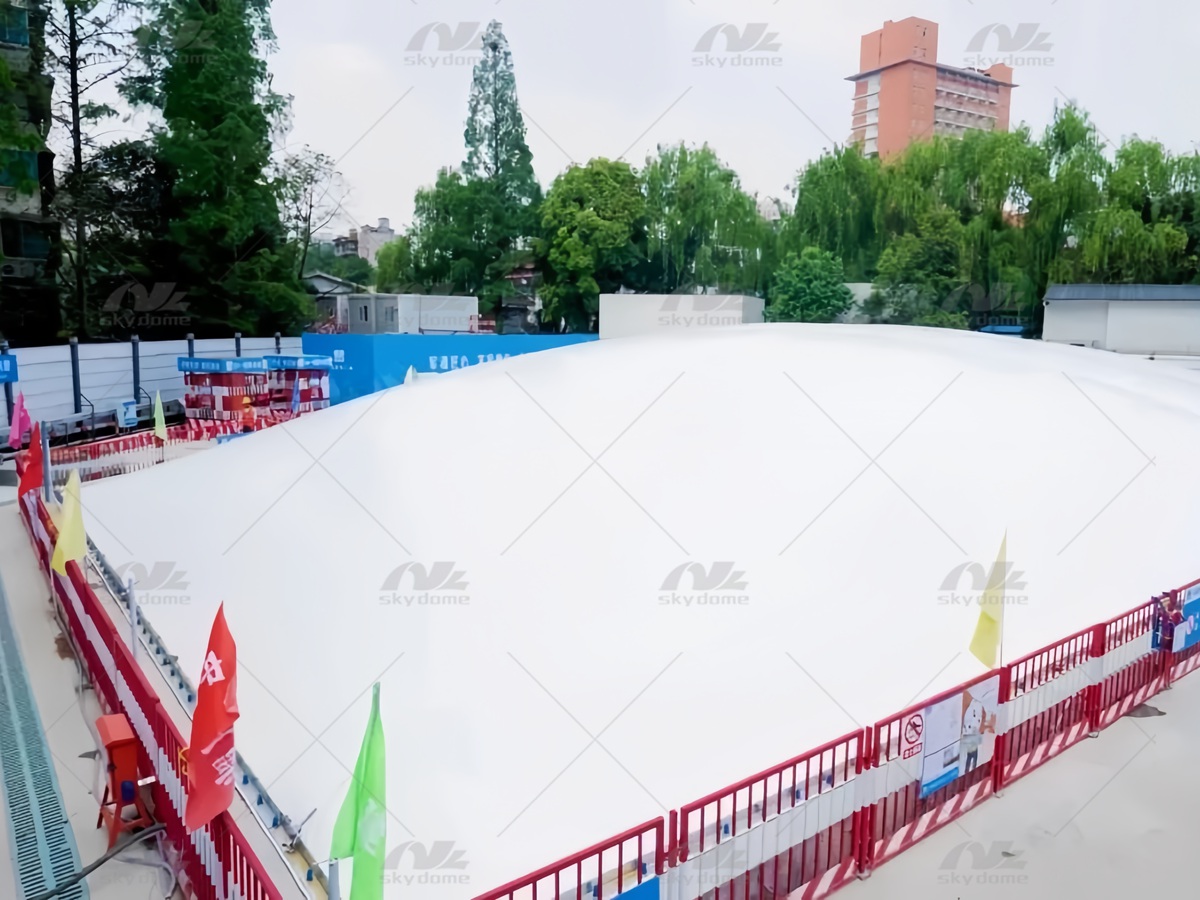
Air-supported structures built for heavy construction use advanced pneumatic engineering. They create massive, clear-span workspaces. Traditional buildings rely on steel or concrete columns. These domes are supported entirely by internal air pressure. The architectural membrane consists of high-tensile PVC or PVDF fabrics, typically weighing between 28 and 35 ounces per square yard. Continuous air supply inflates and maintains the shape. You get an unobstructed interior environment. It easily houses towering cranes, massive excavators, and complex foundation logistics without internal pillars blocking your equipment.
Installation mechanics prioritize rapid deployment to minimize site downtime. Site preparation starts with laying a continuous anchoring system around the excavation perimeter. Depending on soil reports, engineers use concrete ballasts, helical earth anchors, or existing foundation walls to secure the membrane. Crews unroll the fabric and clamp it to the anchoring system using heavy-duty aluminum track channels. High-capacity blowers then initiate the inflation process. This rapid transformation turns an exposed pit into a fully protected workspace in just a few days. It vastly outpaces traditional hard-shell construction methods.
Structural integrity relies on precise pressure calculations. Engineers determine the exact internal pressure needed to withstand external environmental forces. They calculate for high wind loads and heavy snow accumulation. A network of steel cable harnesses reinforces the exterior of the membrane. This wire grid distributes stress evenly across the structure, preventing the fabric from tearing under extreme tension. During severe weather, automated systems increase internal pressure. This stiffens the dome, prevents deflection under heavy snow loads, and keeps the fabric taut against gale-force winds.
Air Handling Units (AHU) and pressure regulation systems form the mechanical heart of the structure. Automated variable frequency drive (VFD) blowers continuously monitor internal pressure using smart sensors. Heavy machinery entering or exiting through airlock tunnels causes a temporary loss of air. The VFD blowers instantly detect this pressure drop. They ramp up their output to compensate and ensure the dome remains structurally stable. Redundant blower systems run in parallel. This guarantees continuous operation even when mechanics perform routine maintenance on the primary units.
Urban construction sites face intense scrutiny regarding airborne particulate matter. Effective dust control is a strict regulatory requirement, not just a preference. Pneumatic enclosures use negative or positive pressure dynamics combined with integrated industrial scrubbers. They trap particulate matter directly at the source. Excavators dig and trucks haul dirt, kicking up heavy dust. The system pulls this suspended dirt through heavy-duty MERV-rated filtration units instead of letting it drift into neighboring residential areas. This filtration ensures cleaner urban construction and stops municipal stop-work orders caused by air quality violations.
Acoustic engineering plays a massive role in maintaining community relations during the loudest phases of foundation work. Blasting, deep drilling, and pile driving generate severe noise pollution, often exceeding 90 decibels. Heavy-duty PVC and PVDF architectural membranes possess significant decibel-dampening properties. The trapped layer of air within the dome acts as a massive acoustic barrier alongside the dense fabric. This noise reduction capability drops the noise level at the property line by 20 to 30 decibels. You can run crews into the night or early morning without violating local noise ordinances. This accelerates the overall project schedule.
Thermal regulation and moisture control keep all-weather construction moving. Sub-zero temperatures halt concrete pouring and freeze the ground, which stops excavation dead in its tracks. Air domes integrate seamlessly with commercial HVAC systems and industrial dehumidifiers. The insulated membrane retains heat during winter months. It prevents the ground from freezing and creates optimal ambient temperatures for concrete curing. During humid or rainy seasons, dehumidification systems manage internal condensation. The workspace remains dry, safe, and ready for heavy machinery operation. Workers do not need bulky winter gear, which improves their mobility and safety on site.
Complex excavation footprints require highly adaptable sheltering solutions. Custom sizing allows engineers to design membranes that cover irregular pit shapes, exceptionally deep excavations, and massive square footages. The structure relies on air pressure rather than internal support pillars. There are virtually no limits to the clear-span width, with some domes spanning over 300 feet across. This architectural flexibility ensures you can fully enclose unconventionally shaped urban lots. You never compromise the internal maneuvering space required for heavy construction equipment.
Equipment access presents a major logistical challenge when operating inside a pressurized environment. Engineers design specialized vehicle airlock tunnel systems to prevent the dome from depressurizing when vehicles enter and exit. These heavy-duty airlocks feature dual-door mechanisms. A dump truck enters the first set of doors. Those doors close behind it before the second set opens into the main dome interior. The airlock dimensions are customized to fit standard concrete mixer trucks and articulated dump trucks. This system accommodates massive excavators, continuous concrete truck deliveries, and mobile cranes. You get seamless logistics without compromising the structural stability of the enclosure.
Meeting municipal building codes and fire safety standards is mandatory for any temporary structure. A compliant construction site enclosure must use strictly flame-retardant membrane materials that meet NFPA 701 standards. These fabrics self-extinguish and prevent the spread of fire. The design must incorporate clearly marked, pressure-sealed emergency exits for personnel. Heavy diesel machinery operates continuously inside the dome, meaning ventilation standards must exceed normal requirements. High-capacity exhaust fans and air exchange systems are strategically integrated. They monitor and expel carbon monoxide and diesel fumes, ensuring a safe breathing environment for all on-site workers.
Evaluating the financial viability of a pneumatic enclosure requires comparing capital expenditure against operational savings. The upfront investment to engineer, manufacture, and install a massive air-supported structure is substantial. However, this initial cost is rapidly offset by the financial benefits of uninterrupted labor and equipment utilization. Eliminating weather days means you stop paying idle equipment rental fees and extended labor costs. Accelerating the critical path schedule allows for earlier project completion. This translates directly to earlier revenue generation or occupancy for the developer.
Reusability significantly enhances the long-term value of the investment. The architectural membrane and mechanical components are built for multi-project deployment. Once a foundation is poured and the structure reaches grade level, crews systematically deflate, clean, fold, and transport the dome to the next excavation site. Large-scale general contractors amortize this asset across multiple future foundation projects. This drastically lowers the per-project sheltering cost and turns a one-time expense into a recurring logistical advantage. You are buying a piece of heavy equipment, not just a disposable tarp.
Energy consumption represents the primary operational trade-off. Maintaining structural stability requires continuous electrical or diesel power to run the primary and backup blowers 24/7. Site managers must factor in the ongoing utility costs of continuous pressurization, heating, and active filtration. The energy draw is constant, but the expense is generally far lower than the financial penalties associated with weather-delayed schedules, frozen ground remediation, or municipal fines for environmental non-compliance.
Power failure is the most critical risk associated with air-supported structures. The dome relies entirely on internal air pressure. A sudden loss of grid power causes the structure to slowly deflate. Redundancy is engineered into the system from day one to mitigate this risk. Automated backup generators and redundant power supplies are mandatory. Smart control panels monitor the incoming electrical feed. The millisecond grid power drops, the system automatically switches to diesel backup generators. The blowers never stop running, and the dome remains fully pressurized.
Fabric membrane vulnerabilities require strict site protocols. The PVC/PVDF material is highly durable, but it is not immune to punctures from careless heavy machinery operation, swinging crane loads, or flying debris. Site managers must establish clear operating zones and speed limits within the dome. The structure will not instantly collapse in the event of a puncture. The blowers automatically increase output to compensate for the air leak. Standard operating procedures dictate keeping rapid on-site patching kits available. Maintenance crews clean the area, apply an industrial heat gun, and roll a permanent patch over the tear within minutes.
Vetting a reliable air dome manufacturer is the most important step in mitigating implementation risks. Decision-makers should use a strict evaluation checklist. Key indicators of a capable vendor include a robust in-house engineering team, transparent load-testing data for wind and snow, and a proven track record of integrating heavy machinery airlocks. Evaluate their post-installation support capabilities, emergency response times, and the comprehensiveness of their warranty terms. A vendor must act as a technical partner, not just a material supplier, to ensure the complex deployment goes smoothly.
Conduct a comprehensive site footprint analysis to determine the required clear-span dimensions and optimal anchoring methods for your specific excavation zone.
Calculate baseline delay costs using historical weather data, idle equipment rentals, and potential municipal fines to establish a clear return on investment threshold.
Request a detailed load-calculation feasibility study from shortlisted vendors to verify structural integrity against local extreme weather patterns.
Map out equipment logistics to determine the exact size, location, and quantity of vehicle airlocks required for seamless daily operations.
A: Engineered load capacities vary by design, but heavy-duty domes can withstand hurricane-force winds and heavy snow loads. Reinforced steel cable-net systems distribute stress across the membrane. Automated variable frequency drive blowers instantly increase internal pressure to stiffen the structure during severe weather events.
A: Once the perimeter anchoring system is prepared and the concrete ballasts are set, deployment is rapid. Unrolling the membrane, securing it to the anchors, and completing the pneumatic inflation process typically takes only a few days. This drastically reduces site downtime compared to erecting traditional steel scaffolding.
A: Yes. Despite being temporary structures, pneumatic enclosures generally require municipal building permits. Local codes vary, but officials will review the engineering data for wind and snow loads, fire-retardant material certifications, emergency egress plans, and ventilation standards before granting approval for deployment.
A: Heavy machinery enters through specialized vehicle airlock tunnel systems featuring a dual-door mechanism. A truck enters the first door, which closes to seal the chamber before the second door opens into the main dome. This prevents air loss and maintains the structural pressure of the enclosure.
A: Air domes are equipped with automated, redundant power systems. If grid power fails, smart sensors instantly trigger on-site diesel backup generators to keep the blowers running seamlessly. Even in a total catastrophic power failure, the dome deflates very slowly, allowing ample time for safe personnel evacuation.
A: The enclosed space traps particulate matter at the source. By utilizing negative pressure dynamics and integrating industrial air scrubbers, the system filters suspended dirt and exhaust before venting clean air outside. This easily meets strict EPA and local urban environmental standards.
A: Yes. The high-tensile PVC or PVDF fabric and mechanical components are designed for multi-project lifecycles. Once a foundation is complete, the dome can be deflated, cleaned, folded, and stored in a dry facility until it is transported and re-anchored at the next excavation site.


