
T: +86-137-0128-0809
E: sales@skyairdome.com
E: sales@skyairdome.com
UNIT 1406B, 14/F, THE BELGIAN BANK BUILDING, NOS. 721 - 725 NATHAN ROAD, KOWLOON, HONG KONG

Views: 0 Author: Site Editor Publish Time: 2026-08-19 Origin: Site


Proper lighting inside an inflatable tennis facility dictates player satisfaction and operational success. Facility managers face a specific challenge when designing these spaces. They must balance high-visibility needs for racquet sports with strict structural limitations. Inflatable structures present unique installation complexities and specific energy demands. Evaluating these lighting systems requires looking far beyond simple brightness metrics. You must consider structural integration, fabric reflectivity, and smart control capabilities. A well-designed system ensures a viable, high-performance facility. We will examine the structural realities of suspending fixtures in an air-supported environment. You will learn how to mitigate installation risks and maximize long-term operational efficiency.
Recreational play requires 30–50 footcandles, while professional or competitive matches demand 75–100 footcandles with strict uniformity.
Integrating a transparent membrane tennis air dome design can significantly offset daytime energy costs, especially when paired with automated daylight harvesting sensors.
Indirect LED lighting systems are the industry standard for minimizing glare and maximizing the reflective properties of dome fabrics.
Lighting a tennis air dome requires strict adherence to established illuminance standards. These standards are measured in footcandles (fc) or lux. The specific light levels required depend entirely on facility usage. Recreational facilities do not need the same intensity as professional venues. Club-level play generally requires 30 to 50 footcandles. This translates to roughly 300 to 500 lux. This level provides ample visibility for casual matches and training sessions. It balances player comfort with energy efficiency.
Competitive and professional standards demand significantly higher output. Tournaments and high-stakes matches require 75 to 100 footcandles. This equals 750 to 1000 lux. High-speed ball tracking becomes impossible without this intensity. The small size and high velocity of a tennis ball necessitate rapid visual processing. Players must read the spin and trajectory instantly. Insufficient lighting leads to delayed reaction times and poor match quality. Facility managers must define their target audience before selecting a lighting package. Upgrading a recreational system to professional standards later involves significant structural modifications.
Brightness alone does not guarantee a high-quality playing environment. Light distribution across the court is equally critical. This distribution is measured by the uniformity ratio. A poor uniformity ratio creates alternating dark spots and bright pools. These inconsistencies severely disrupt a player's depth perception. The human eye struggles to adjust rapidly between varying light intensities. This causes eye strain and degrades athletic performance.
Tennis governing bodies mandate specific uniformity targets. The max-to-min ratio compares the brightest spot on the court to the darkest. A standard acceptable max-to-min ratio is 2.0 or lower for competitive play. The average-to-min ratio is another metric. It compares the overall average illuminance to the lowest recorded point. This ratio should ideally sit below 1.5. Achieving these ratios in an inflatable structure requires precise photometric planning. Engineers must calculate the exact placement and angle of every fixture. They must account for the curvature of the dome ceiling. This curvature naturally disperses light differently than a flat roof.
Glare control is the most challenging aspect of tennis facility lighting. The Unified Glare Rating (UGR) quantifies the visual discomfort caused by light sources. A lower UGR indicates less glare. Tennis players frequently look directly upward during serves and lobs. Direct overhead lighting can temporarily blind a player in these moments. This blinding effect ruins the competitive integrity of the game. It also creates a frustrating experience for paying members.
Minimizing UGR requires specific technological approaches. Direct lighting fixtures must feature heavy diffusion lenses. These lenses scatter the light rays to soften the visual impact. Diffusion alone is rarely sufficient for professional standards. Indirect lighting remains the most effective solution for minimizing glare. Indirect systems bounce light off the reflective interior of the dome. This turns the entire ceiling into a massive, soft light source. The resulting illumination is highly uniform and virtually glare-free. Players can track high lobs without ever looking into a concentrated light diode.
Selecting the right fixture type is a foundational engineering decision. Facility managers must choose between direct and indirect LED systems. Each approach offers distinct advantages and specific drawbacks. Direct LED systems point the light source straight down at the playing surface. Indirect systems point the light upward, utilizing the ceiling as a reflector. The choice impacts energy consumption, visual comfort, and installation complexity within an indoor tennis court air dome.
Direct LED fixtures boast high electrical efficiency. They deliver lumens directly to the target area with minimal loss. You need fewer fixtures to achieve target footcandles. The glare risk is exceptionally high. Direct fixtures often cast harsh, distinct shadows behind the players and the ball. These shadows interfere with visual tracking. Players frequently complain about the harshness of direct lighting during serving motions.
Indirect LED systems provide vastly superior visual comfort. They eliminate harsh shadows by creating a diffuse, omnidirectional light environment. The glare is practically non-existent. Indirect systems require a higher total lumen output. A portion of the light is absorbed by the fabric rather than reflected. You must install more powerful fixtures to achieve the same footcandles at court level. The success of an indirect system depends entirely on the fabric's reflectivity.
Feature | Direct LED Systems | Indirect LED Systems |
|---|---|---|
Visual Comfort | Low (High glare risk during serves) | High (Soft, diffuse illumination) |
Shadowing | Harsh, distinct shadows | Minimal to no shadows |
Energy Efficiency | High (Direct lumen delivery) | Moderate (Relies on fabric reflection) |
Fixture Quantity Needed | Fewer fixtures required | More fixtures required |
Best Use Case | Standard recreational facilities | Premium clubs and competitive venues |
Modern inflatable structures offer unique opportunities for natural light integration. Utilizing sunlight reduces reliance on artificial fixtures during peak hours. This strategy significantly lowers daily operational demands. Many facilities incorporate translucent skylight sections along the apex of the structure. These sections allow diffused sunlight to flood the courts. The curved nature of the dome helps distribute this natural light evenly.
A transparent membrane tennis air dome takes this concept further. These structures utilize highly translucent fabrics across large sections of the envelope. During clear days, the interior achieves optimal footcandles without a single LED powered on. The natural light provides perfect color rendering. Players universally prefer the visual clarity of natural sunlight. It creates an inviting, open-air atmosphere while maintaining climate control.
Daylight harvesting maximizes the operational benefits of natural light. This strategy involves integrating automated photosensors into the lighting network. The sensors continuously monitor ambient light levels inside the dome. As the sun rises, the sensors automatically dim the LED fixtures. If cloud cover rolls in, the system instantly increases artificial output. This dynamic adjustment ensures consistent footcandles at all times. It prevents energy waste while maintaining strict uniformity ratios.
Operational efficiency requires precise control over the lighting environment. Multi-court facilities cannot afford to illuminate empty spaces. Smart controls provide the necessary flexibility for modern facility management. Programmable LED drivers serve as the foundation of these systems. They allow managers to group fixtures into specific operational zones. Each tennis court can function as an independent lighting zone.
Court zoning directly impacts facility efficiency. When a court is unbooked, managers can dim or extinguish its lights entirely. Adjacent active courts remain fully illuminated. Advanced systems integrate directly with facility booking software. The lights automatically activate five minutes before a scheduled match. They dim down to a safety level immediately after the reservation ends. This eliminates human error from energy management. Staff members no longer need to manually toggle breaker switches.
Smart controls also facilitate multi-use scenarios. A facility might host a professional tournament one weekend and a junior clinic the next. Managers can program custom lighting scenes for different events. A tournament mode pushes all fixtures to 100 footcandles. A practice mode caps output at 40 footcandles. This adaptability extends the lifespan of the LED diodes. Running fixtures below their maximum capacity significantly reduces thermal stress.
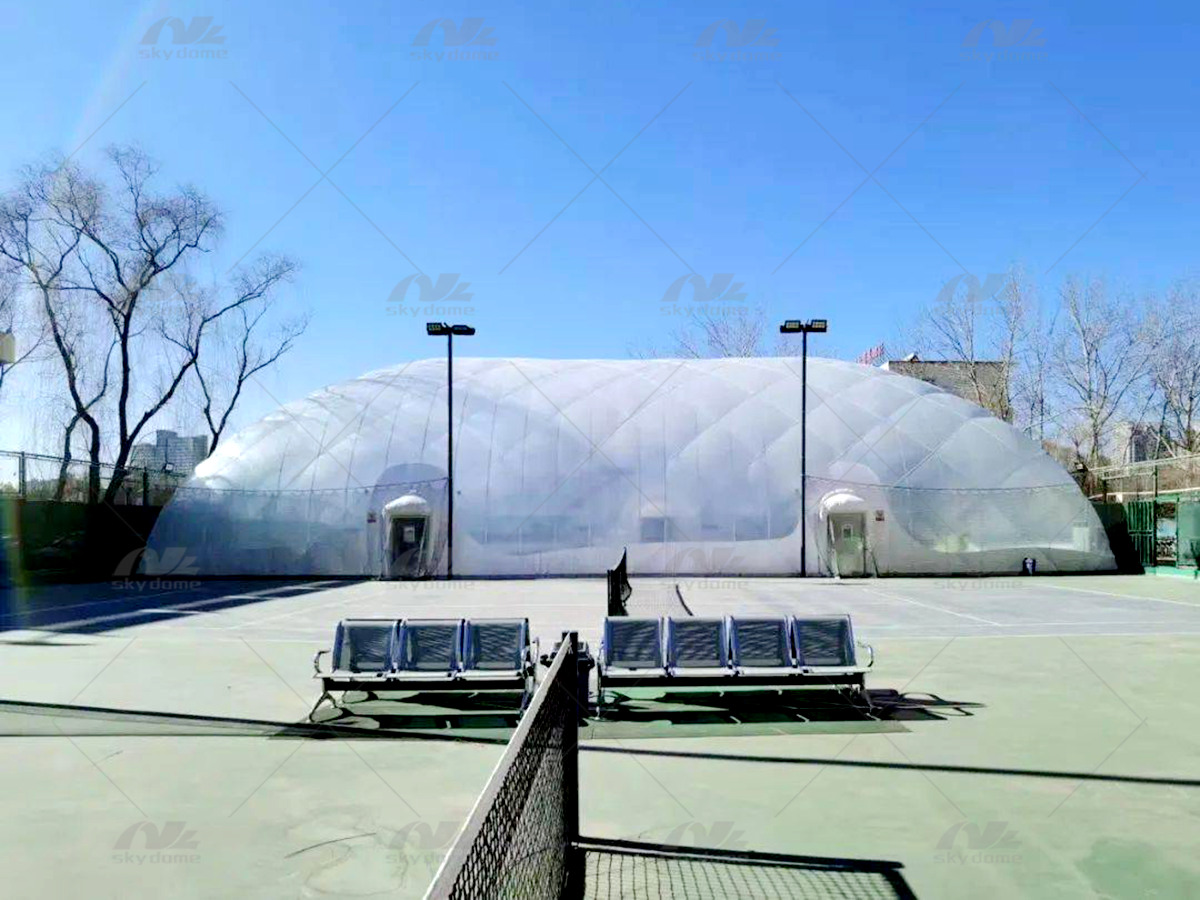
The interior surface of an inflatable structure acts as a massive optical reflector. The efficiency of your lighting system depends heavily on this surface. The fabric's chemical composition dictates its reflective capabilities. Standard PVC fabrics degrade and yellow over time. This yellowing absorbs light and drastically reduces interior brightness. Facility managers must then push their LEDs harder to compensate, wasting energy.
A PVDF tennis air dome solves this degradation problem. Polyvinylidene fluoride (PVDF) is an advanced architectural coating. It provides exceptional resistance to UV degradation and airborne pollutants. PVDF materials boast a remarkably high Light Reflectance Value (LRV). They bounce a maximum percentage of lumens back down to the court surface. This high LRV is absolutely mandatory for indirect lighting systems.
PVDF coatings also offer self-cleaning properties. Dirt and dust accumulation on the interior ceiling destroys lighting efficiency. The smooth, low-friction surface of PVDF prevents particulate adhesion. The fabric maintains its brilliant white finish year after year. This sustained reflectivity ensures your photometric calculations remain accurate over the structure's lifespan. You will not need to add supplemental fixtures five years after installation.
Mounting heavy equipment in an air-supported environment requires specialized engineering. Traditional steel-truss lighting fixtures are far too heavy for inflatable roofs. The fabric envelope relies entirely on internal air pressure for structural integrity. Excessive point loads can distort the fabric membrane. This distortion compromises the dome's aerodynamic profile and structural safety. Lighting systems must be engineered specifically for low-weight applications.
Evaluating fixture weight is a procurement step. Manufacturers utilize extruded aluminum housings to shed unnecessary pounds. The power supplies and drivers are often mounted remotely at ground level. This removes significant weight from the suspended ceiling harness. The suspension mechanics must also account for dynamic movement. An air dome flexes and shifts under external wind loads. Rigid mounting brackets will tear the fabric during a storm.
Engineers utilize flexible suspension cables and sway mitigation harnesses. These systems allow the fixtures to move independently of the fabric envelope. The cables absorb the kinetic energy generated by wind gusts. This prevents structural strain and keeps the light beams focused precisely on the courts. Proper sway mitigation ensures the uniformity ratio remains stable even during severe weather events.
Installing lighting in an inflatable structure follows a unique sequence. You cannot bring in scissor lifts after the dome is fully pressurized. The delicate court surface cannot support heavy machinery. The entire lighting system must be integrated during the initial construction phase. This requires flawless coordination between the dome manufacturer and the electrical contractors.
The installation process follows a strict sequence:
Technicians map out the exact fixture locations on the deflated fabric envelope based on the photometric plan.
Suspension harnesses are attached directly to reinforced structural seams to distribute weight evenly.
Electrical wiring is routed through specialized fabric sleeves to protect cables from abrasion and moisture.
All wiring and hardware are meticulously secured and tested before the inflation fans activate.
As the dome pressurizes, it lifts the lighting network into place, pulling the suspension cables taut.
Technicians perform final aiming and calibration from lightweight scaffolding once the structure is fully inflated.
This integrated approach prevents schedule delays and protects the underlying tennis courts. It highlights the necessity of utilizing in-house engineering teams who understand inflatable dynamics.
Facility managers face a choice during the procurement phase. They can purchase a turnkey package from the dome manufacturer or source third-party lighting. Turnkey bundles streamline the entire construction process. The manufacturer engineers the dome, the lighting, and the climate control as a single cohesive unit. They guarantee that the fixture weight aligns with the fabric's load capacity. They ensure the photometric plan matches the exact curvature of their specific dome model.
Sourcing specialized third-party systems introduces significant integration risks. An independent lighting vendor may not understand the dynamic sway of an air-supported roof. They might specify fixtures that are too heavy or use rigid mounting hardware. The facility manager assumes the burden of coordinating between two separate engineering teams. If a structural failure occurs, warranty disputes often arise between the dome supplier and the lighting vendor.
Turnkey solutions simplify maintenance protocols. You have a single point of contact for all technical support. The manufacturer provides comprehensive documentation for the entire integrated system. This unified approach reduces administrative overhead and ensures long-term operational stability. It is generally the safest route for complex inflatable sports facilities.
Evaluating lighting proposals requires a long-term perspective. High-efficiency LED systems require a larger initial capital allocation. Premium diodes, programmable drivers, and daylight harvesting sensors increase the initial equipment footprint. These technologies drastically reduce monthly electrical consumption. Facility managers must calculate the efficiency return based on their local utility rates.
Long-term performance relies heavily on thermal management. LED diodes degrade rapidly when exposed to excessive heat. High-quality fixtures utilize advanced heat sinks to dissipate thermal energy. This engineering extends the lifespan of the fixture well beyond 100,000 hours. You avoid the recurring maintenance cycles of replacing burnt-out bulbs and failing ballasts. The operational savings quickly offset the initial capital requirements.
Smart controls further enhance long-term operational performance. Dimming fixtures during low-occupancy hours reduces thermal stress on the diodes. This practice extends the usable life of the entire lighting network. Investing in robust, programmable infrastructure yields compounding returns over the facility's lifespan. It transforms tennis air dome lighting from a static utility draw into a manageable operational asset.
Lighting systems do not operate in a vacuum. They interact directly with the facility's climate control infrastructure. Every watt of electrical energy consumed by a light fixture eventually becomes heat. This thermal footprint significantly impacts HVAC performance within an all-weather tennis air dome. Engineers must account for this interplay when sizing the mechanical equipment.
During summer operation, ambient temperatures can reach 90°F. The air-conditioning system must work aggressively to maintain player comfort. Legacy lighting systems, like metal halides, emit massive amounts of radiant heat. This forces the AC units to consume excess energy just to cool the lights. Energy-efficient LEDs run significantly cooler. They drastically reduce the cooling load, lowering summer utility loads and preventing HVAC overexertion.
Winter operation presents a different dynamic. Outside temperatures can plummet to -10°F. Legacy lighting systems actually contributed to the heating effort. Because LEDs emit minimal heat, the HVAC system must handle 100% of the heating load. Facility managers must ensure their heating units are sized appropriately for an LED environment. The dome's insulation package becomes critical for retaining the heat generated by the mechanical systems.
Poor quality lighting introduces severe visual hazards. Flicker is a common issue with low-tier LED drivers. The human eye may not consciously detect high-frequency flicker. The brain processes it, leading to rapid eye fatigue and headaches. In a sport like tennis, flicker creates a dangerous stroboscopic effect. The moving ball appears to stutter or jump across the visual field.
This stroboscopic effect destroys a player's timing and coordination. Tracking a 100-mph serve becomes physically impossible. Facility managers must mandate the specification of flicker-free drivers. These advanced drivers provide a smooth, continuous flow of electrical current to the diodes. They eliminate the microscopic power interruptions that cause flickering. Always demand technical specification sheets verifying the flicker percentage is near zero.
Testing for flicker before final installation is highly recommended. You can use specialized light meters or even slow-motion smartphone cameras to detect invisible pulsing. Catching this issue early prevents disastrous feedback from club members. Investing in premium, flicker-free drivers protects the athletic integrity of your facility.
Maintaining equipment suspended 30 to 40 feet in the air presents logistical nightmares. You cannot simply roll a heavy boom lift onto a delicate acrylic tennis court. The tires will permanently damage the playing surface. Repairing a single broken fixture can require laying down extensive protective flooring. This process consumes hours of labor and forces extended court closures.
Mitigating this risk requires proactive procurement strategies. Prioritize modular fixture designs. If a driver fails, technicians should be able to swap the component without removing the entire housing. Specify extended-life LEDs with an L70 rating exceeding 100,000 hours. This means the lights will maintain 70% of their initial brightness for over a decade of typical use.
Some advanced systems utilize motorized suspension cables. These winches allow maintenance staff to lower individual fixtures down to court level. Technicians can perform repairs safely from the ground. This eliminates the need for heavy lift equipment and prevents surface damage. While motorized systems require higher initial capital, they provide unparalleled maintenance accessibility.
To ensure your facility operates efficiently and provides an optimal playing environment, follow these immediate next steps:
Request a site-specific photometric analysis from your dome manufacturer to verify exact fixture placement and uniformity ratios.
Audit your current or proposed fabric specifications to confirm the inclusion of a high-LRV PVDF coating.
Consult with a structural engineer to validate that your chosen lighting harness system includes dynamic sway mitigation.
Integrate automated daylight harvesting sensors into your electrical plan before finalizing the construction planning.
A: Recreational play requires 30 to 50 footcandles. Competitive and professional play requires 75 to 100 footcandles for optimal visibility. Achieving these levels ensures players can accurately track high-speed balls without experiencing eye strain or delayed reaction times.
A: Yes. Utilizing translucent fabrics or a transparent membrane design allows facilities to harvest daylight. This natural light provides excellent visibility. You can pair it with smart photosensors to automatically dim artificial lights, significantly reducing daytime energy consumption.
A: Indirect LED lighting systems are highly recommended. They offer superior energy efficiency and feature low-weight designs suitable for inflatable structures. They also eliminate blinding glare by reflecting diffuse light off the dome ceiling.
A: PVDF fabrics possess high interior reflectivity and resist yellowing over time. This high Light Reflectance Value (LRV) maximizes the efficiency of indirect lighting systems. It reduces the total number of fixtures needed to achieve target brightness.
A: Yes. LEDs emit significantly less heat than traditional metal halide fixtures. This drastically reduces air-conditioning loads during summer operation. However, it requires the facility's HVAC system to handle 100% of the heating load during winter months.
A: Purchasing a turnkey package from the manufacturer is generally safer. These estimates include in-house engineered LED lighting and HVAC systems. This ensures perfect structural compatibility, proper weight distribution, and a streamlined installation process.


